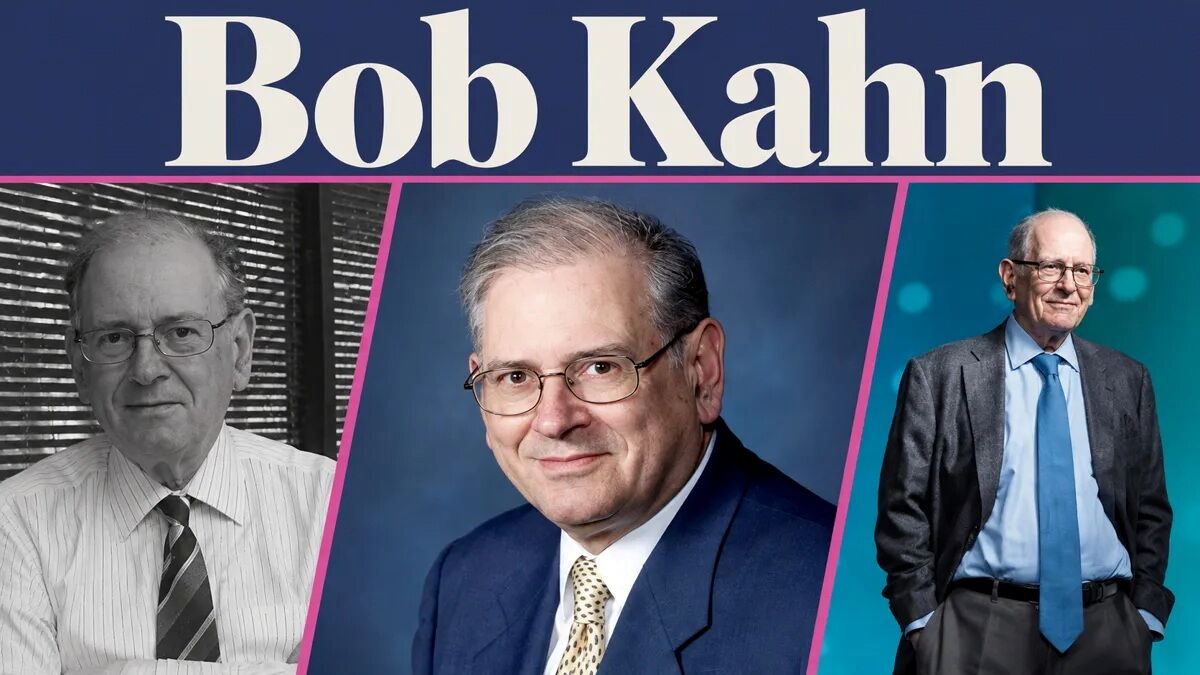
Who Bob Kahn Is and Why He Matters
Bob Kahn ranks high among the contemporary world’s shapers. Bob Kahn, a leading Internet architect, is widely recognized. His work established the principles that allowed computer networks to communicate, connecting isolated devices worldwide. If the Internet is a highway, Kahn designed its lanes, signage, and bridges.
Kahn was born in Brooklyn on December 23, 1938, into a century of electronics, telecommunications, and computing. He was not a consumer tech founder’s celebrity. His creation was deeper and more lasting. Like city bedrock, his effect is underground.
Early Life and Family Background
Brooklyn, famed for generating driven New Yorkers, birthed Bob Elliot Kahn. He came from an Ashkenazi Jewish family with a long history of learning, endurance, and adaptation. Although he has kept his family life secret, that background is essential to him.
Lawrence and Tashker-born Beatrice Pauline Kahn were his parents. They are hardly known, yet their part in his story crucial. Every innovator starts somewhere, and a future Internet pioneer’s technical talent was shaped by discipline, education, and curiosity in his family.
Unlike many public figures, Kahn has not spent his life narrating his upbringing in interviews or memoir-like reflections. That privacy creates an interesting contrast. His work connected billions of people, yet his own personal circle has stayed largely out of the spotlight.
Parents and Family Members
Lawrence Kahn
Bob’s dad is Lawrence Kahn. He remains a shadow in Bob Kahn’s biography since public documents don’t reveal much about his career or life. Still, fathers often set an example of stability, ambition, or moderation, and it’s hard not to ponder how that may have impacted a son who redefined global communication.
Some family references also connect the broader Kahn family name with other notable individuals, including futurist Herman Kahn. That does not automatically define Bob Kahn’s immediate home life, but it places his family name within a wider landscape of intellectual seriousness.
Beatrice Pauline Kahn
Beatrice Pauline Kahn, Bob’s mother, rarely speaks publicly. Life sources identify her by her maiden name, Tashker, even if they offer little facts. Mothers played important roles in many lives, notably those of 1930s males, but rarely appear in public biographies. My opinion is that silence speaks for itself. After the construction is finished, the scaffolding of a wonderful life is frequently inconspicuous.
Spouse: Patrice Ann Lyons
Bob Kahn is popularly known to be married to Patrice Ann Lyons. Besides her name, little is known about her. Their private life, marriage, and household are not well-known. That lack is typical for Kahn’s generation and temperament. He established processes, directed institutions, and affected policy without notoriety.
In an age when public figures often turn family into part of their public brand, Kahn stands apart. His privacy has remained intact, almost like a closed laboratory door in a world of glass offices.
Children and Siblings
There is no publicly verifiable Bob Kahn child identification. In the public biographical record, no siblings are reliably established. That doesn’t imply no relatives exist. It simply implies they have not been publicly verified. That difference applies when writing about a meticulously private individual.
Education and Intellectual Formation
Kohn’s education was rigorous and straightforward. City College of New York awarded him a Bachelor of Electrical Engineering in 1960. That accomplishment put him on a solid technological footing as electronics and communications became more important to society.
He earned a Master of Arts in Electrical Engineering in 1962 and a Ph.D. in Electrical Engineering in 1964 at Princeton University. His dissertation research was in signal sampling and modulation theory, a technological discipline that studied information representation, transmission, and interpretation. Looking retrospect, it seems prescient. He studied precise signal travel before linking networks.
Career Beginnings Before Internet Fame
Kahn worked at Bell Laboratories from 1964 to 1966 after Princeton. Bell Labs was a major 20th-century innovator, turning ideas into life-changing technologies. Working there exposed him to rigorous research and ambitious engineering.
He later served as an Assistant Professor at the Massachusetts Institute of Technology. That move shows a mind comfortable not only with research but also with explanation and mentorship. Teaching often sharpens thought, forcing complex ideas into clear form.
Bolt Beranek and Newman (BBN) hired Kahn in 1969. A decisive step. Packet-switching networks and ARPANET technologies were his focus at BBN. Packet switching revolutionized data by breaking it apart, sending it across a network, and reassembling it. It was like sending a book chapter by chapter and expecting the postal system to deliver the whole novel.
The ARPANET Demonstration and DARPA Years
One of Kahn’s major early public achievements came in 1972, when he organized a landmark demonstration of the ARPANET. This event helped show that large-scale networked computing was not just theoretical but practical. It gave form to an idea that many people had only dimly imagined.
DARPA hired him that year. He was program manager and then Information Processing Techniques Office director. That view showed him doing more than experiments. He shaped future communication architecture.
The DARPA years were crucial because Kahn faced a core problem: different networks could exist, but how could they communicate reliably with each other? Solving that challenge required more than clever engineering. It required a unifying vision.
Creating TCP/IP with Vinton Cerf
Kahn’s most famous achievement was his collaboration with Vinton Cerf in 1973 and 1974 on the design of TCP and IP, the protocols that became the foundation of the Internet.
Data was reliably sent via TCP. Addressing and routing were done via IP. They let information to be transferred between networks without needing standardization. The breakthrough. Instead of one huge consistent system, Kahn and Cerf connected several systems.
The ARPANET standard was TCP/IP by 1983. Digital history changed on that date. There was no flash. There were no flashy product debuts. However, it enabled the networked world that now shapes business, media, research, education, and discussion.
Founding CNRI and Pursuing New Ideas
In 1986, Kahn founded the Corporation for National Research Initiatives, or CNRI, and became its president. This nonprofit organization focused on information infrastructure, networking technologies, digital libraries, persistent identifiers, and digital object architecture.
His subsequent career is very illuminating. Kahn wasn’t happy with helping construct the Internet. He contemplated the following layer. Digital information organization: how? How may network objects stay recognizable when their locations change? Though abstract, these considerations determine digital knowledge’s persistence.
His work on Digital Object Architecture showed the same pattern visible throughout his career: a preference for invisible infrastructure that makes visible systems reliable.
Major Honors and Recognition
Kahn has received top scientific and public honors. His Internet development work earned him the Charles Stark Draper Prize in 2001. He and Vinton Cerf won the 2004 Turing Award for internetworking and TCP/IP pioneering. He received the Presidential Medal of Freedom in 2005.
In 2012, he was inducted into the Internet Hall of Fame as an inaugural member. These honors reflect more than personal distinction. They acknowledge that Kahn’s work altered the structure of modern civilization.
Key Dates at a Glance
| Year | Event |
|---|---|
| 1938 | Born in Brooklyn, New York |
| 1960 | Earned engineering degree from City College of New York |
| 1962 | Completed M.A. at Princeton University |
| 1964 | Completed Ph.D. at Princeton University |
| 1964 | Began work at Bell Laboratories |
| 1969 | Joined BBN |
| 1972 | Organized major ARPANET demonstration |
| 1972 | Joined DARPA |
| 1973 | Began TCP/IP design collaboration with Vinton Cerf |
| 1983 | TCP/IP became ARPANET standard |
| 1986 | Founded CNRI |
| 2001 | Received Draper Prize |
| 2004 | Received Turing Award |
| 2005 | Received Presidential Medal of Freedom |
| 2012 | Inducted into Internet Hall of Fame |
Public Image, Personality, and Private Life
What stands out most to me about Bob Kahn is the contrast between public impact and private reserve. He is one of the most consequential engineers of the last hundred years, yet he has not lived as a public celebrity. His image is scholarly, institutional, and restrained.
His lack of a published net worth figure matches the pattern. Kahn focused on research, government-backed innovation, and nonprofit leadership rather than commercial companies that make inventors billionaires. A legacy of invisible reach, not tangible wealth.
Internet architecture, digital object systems, and networked communication remain his signature topics. Academics and technologists have appreciated him in recent years, notably in discussions on Internet history and future information systems.
FAQ
Who is Bob Kahn?
Bob Kahn, whose full name is Robert Elliot Kahn, is an American electrical engineer and computer scientist best known as one of the inventors of the Internet. He is most famous for co-developing the TCP/IP protocols with Vinton Cerf.
When and where was Bob Kahn born?
He was born on December 23, 1938, in Brooklyn, New York, United States.
Who were Bob Kahn’s parents?
His parents were Lawrence Kahn and Beatrice Pauline Kahn, whose maiden name was Tashker.
Who is Bob Kahn’s spouse?
Bob Kahn is widely identified as being married to Patrice Ann Lyons.
Did Bob Kahn have children?
No publicly verified records clearly identify children of Bob Kahn, so that cannot be stated as confirmed.
What did Bob Kahn study?
He studied electrical engineering. He earned his bachelor’s degree in 1960 from the City College of New York, then completed his master’s degree in 1962 and Ph.D. in 1964 at Princeton University.
What is Bob Kahn most famous for?
He is most famous for co-creating TCP/IP with Vinton Cerf. Those protocols became the technical foundation of the Internet.
Where did Bob Kahn work during his career?
He worked at Bell Laboratories, MIT, BBN, DARPA, and later founded CNRI in 1986.
What awards did Bob Kahn receive?
His major honors include the Draper Prize in 2001, the Turing Award in 2004, the Presidential Medal of Freedom in 2005, and induction into the Internet Hall of Fame in 2012.
Why is Bob Kahn called a Father of the Internet?
He is called a Father of the Internet because his work on internetworking and TCP/IP helped create the core architecture that allows different computer networks around the world to communicate as one global system.