Basic Information
| Category | Details |
|---|---|
| Full name | Jaime Arturo Lozano Espín |
| Known as | Jimmy Lozano, El Actor |
| Birth date | September 29, 1978, with some records listing 1979 |
| Birthplace | Mexico City, Mexico |
| Nationality | Mexican |
| Profession | Former professional footballer, football manager, sports director |
| Playing position | Midfielder |
| Main club | Pumas UNAM |
| Mexico national team | 2000 to 2007/2008 |
| Wife | Catalina Caty Serna |
| Children | Luca, Eugenia, and Renata |
| Current role | Sports Director at GFI Academy in Houston, Texas |
| Father | Jaime Lozano Aguilar |
| Mother | Ana Bertha Espín |
A Footballer Born Between Two Worlds
When I look at Jimmy Lozano’s story, the first thing that stands out is how unusual his starting point was. He was born in Mexico City on September 29, 1978, although some records give 1979, into a family where the spotlight was already familiar territory.
His father, Jaime Lozano Aguilar, had competed as an Olympic boxer for Mexico at the 1968 Mexico City Games before moving into acting. His mother, Ana Bertha Espín, became a respected actress in Mexican theater, film, and television. In other words, Jimmy grew up with cameras on one side and competition on the other.
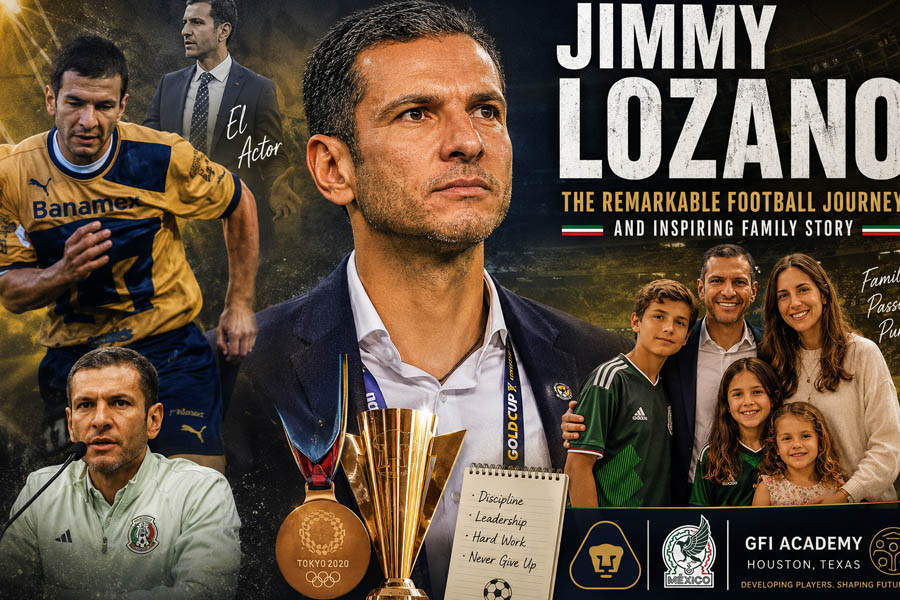
That combination helps explain the nickname “El Actor.” It was a playful reference to his parents’ careers, but Jimmy eventually created a stage of his own. His stage was the football pitch.
From an early age, football captured his imagination. Rather than following his father into boxing or his mother into acting, he became fascinated by the ball, training, movement, and competition. His mother supported that passion while emphasizing discipline, and those lessons would become important long after his playing days ended.
The Family Legacy Behind El Actor
Jaime Lozano Aguilar and Ana Bertha Espín have only one kid, Jimmy. His family history includes two extremely distinct types of performance.
His father competed for Mexico in Olympic boxing at the 1968 Games. Jaime competed in the light welterweight division, finishing ninth with three victories and a disputed loss. Boxing persisted in the family, with Jimmy’s uncle Sergio Lozano later representing Mexico at the 1972 Munich Olympics.
Jaime’s career subsequently shifted from the ring to television and film. He appeared in several projects, including Amor en silencio, Corazón salvaje, Mañana es para siempre, and La rosa de Guadalupe. His path from athlete to actor almost sounds like a screenplay.
Ana Bertha Espín, Jimmy’s mother, also had a well-known career. Born in 1958 in Tehuixtla, Morelos, she studied dramatic literature and theatre at UNAM before becoming well-known to television audiences for her role in Vecinos as Lorena Rivers, Benito’s mother.
Her credits include productions like Cuna de lobos, Quinceañera, Rubí, Soy tu dueña, and La usurpadora. Growing up amid theatre sets and skilled performers taught Jimmy that discipline was more than just an abstract concept. It was part of normal family life.
His parents split while he was young, in 1991 or 1992, following a tough marriage. Jimmy decided to live with his mother. Despite the complications of his childhood, the family story evolved into one of determination rather than discord.
From Pumas Prospect to Mexican Star
Jimmy’s professional football story began with Pumas UNAM, where he made his senior debut in 1998.
I think of his playing style as a mixture of precision and personality. He was a left-footed midfielder who could create opportunities, strike the ball cleanly, and cause problems from set pieces. Free kicks became one of his signatures.
His career included several important chapters:
| Period | Club | Notable detail |
|---|---|---|
| 1998 to 2005 | Pumas UNAM | Established himself as a key midfielder |
| 2001 to 2002 | Celaya | Loan spell |
| 2005 to 2007 | Tigres UANL | Major transfer and increased profile |
| 2007 to 2012 | Cruz Azul | Important extended spell |
| 2010 to 2012 | Morelia | Loan period and SuperLiga success |
| 2012 to 2013/14 | Pumas UNAM | Emotional return and retirement |
Across his senior career, he accumulated roughly 412 appearances and 65 goals.
His defining club years came with Pumas under Hugo Sánchez. In 2004, Pumas won both the Clausura and Apertura championships, completing a memorable bicampeonato. The club also captured the Campeón de Campeones and famously defeated Real Madrid in the Trofeo Santiago Bernabéu.
For a player whose identity was so deeply connected with Pumas, returning to the club at the end of his career carried emotional weight. He reportedly accepted a substantial salary reduction to finish where his professional story had begun.
That decision says something about him. Football careers are often measured in contracts and trophies, but sometimes the most revealing choices are the ones made for sentiment.
Mexico and the International Stage
Lozano earned approximately 34 senior caps for Mexico and scored 12 international goals between 2000 and 2007/2008.
He participated in major competitions including the 2004 and 2007 Copa América, the 2005 Confederations Cup, and Gold Cup competition. Mexico finished fourth at the 2005 Confederations Cup, while the 2007 Gold Cup ended with a runner-up finish.
He also contributed during World Cup qualifying campaigns, although his international career contained the frustrating experience of missing the final squad for the 2006 World Cup.
His profile became so recognizable that he appeared on the North American cover of EA Sports’ 2006 FIFA World Cup video game. It was a small piece of pop culture history that reflected how visible he had become during his playing years.
Finding a New Career on the Touchline
When Lozano retired from playing around 2013 or 2014, he did not leave football behind. Instead, he moved to the other side of the sideline.
He began working in youth development, including with Pumas, before moving into the Querétaro system. He worked as an assistant under Víctor Manuel Vucetich and eventually became Querétaro’s head coach in 2017.
That first major managerial opportunity immediately produced a trophy. Querétaro won the Supercopa MX against América, giving Lozano an early piece of silverware as a head coach.
The real transformation, however, came with Mexico’s youth teams.
The Olympic Bronze Medal That Changed His Coaching Story
From 2018 to 2021, Lozano managed Mexico’s under-23 team and developed a reputation for getting young players to compete with confidence.
His teams earned bronze at the 2019 Pan American Games and finished third at the 2019 Maurice Revello Tournament in Toulon. The biggest moment arrived at the Tokyo Olympics, officially the 2020 Games but held in 2021 because of the pandemic.
Mexico defeated Japan 3 to 1 in the bronze medal match.
The squad featured players who would become important names in Mexican football, including Alexis Vega, Sebastián Córdova, and César Montes. For Lozano, the Olympic medal represented more than another trophy. It validated the youth-development philosophy that would later become a central part of his career.
Mexico Senior Team and the Gold Cup Triumph
After a period with Necaxa in 2022, Lozano received the opportunity that every Mexican coach knows carries enormous pressure.
In June 2023, he took charge of the Mexico senior national team after Diego Cocca’s departure. Initially appointed on an interim basis, he soon made the job permanent for the 2026 World Cup cycle.
His first major achievement was immediate and significant. Mexico won the 2023 CONCACAF Gold Cup, defeating Panama in the final.
The victory brought Lozano back into the national spotlight. He was no longer simply the former Pumas midfielder or the Olympic bronze-winning youth coach. He was now the man responsible for one of the most scrutinized football teams in Mexico.
The following year proved considerably more difficult. Mexico struggled at the 2024 Copa América and exited at the group stage. Lozano was dismissed in July 2024. He reportedly declined an offer to remain in an assistant capacity, preferring to stand by his principles regarding the direction of the project.
Pachuca and a New Chapter
In May 2025, Lozano took over Pachuca with the Club World Cup and Liga MX season ahead.
The Club World Cup brought a major international stage, but Pachuca exited during the group phase. Domestic results were similarly uneven, and Lozano left the club in November 2025 before the Play-In stage.
His departure marked another reminder of how quickly the managerial world can turn. A coach can move from international acclaim to intense criticism in a matter of months.
Yet the story did not end there.
Catalina Serna and a Family Built Around Football and Advocacy
Behind Lozano’s public career is his wife, Catalina “Caty” Serna.
The couple have been together since around 2009, and Catalina has accompanied Jimmy through some of the most demanding periods of his coaching career. A Monterrey native and industrial designer who studied at Tecnológico de Monterrey, she has also developed an important identity of her own through autism advocacy.
Their three children are Luca, Eugenia, and Renata.
Luca, the eldest, was diagnosed with autism, and that experience became a catalyst for Catalina’s advocacy. She helped organize awareness campaigns involving football players, wrote the book Mi hermano Luca in 2017, and later produced a short film based on the same story in 2019.
The family’s public support for autism awareness has become one of the most meaningful parts of their story. Football, in this case, became more than a profession. It became a platform for encouraging understanding and inclusion.
Their children have also appeared in family moments connected with Jimmy’s coaching career. From Olympic celebrations to Liga MX experiences, the family has often been visible together, creating a picture of a household where football is important but family remains the center.
Jimmy Lozano’s Life Beyond the Touchline
In 2026, Lozano’s career entered another interesting phase. Rather than immediately pursuing another senior managerial position, he moved into youth development as Sports Director at GFI Academy in Houston, Texas.
The role fits naturally with the part of his career that has arguably produced some of his most distinctive work.
GFI’s approach emphasizes technical, tactical, cognitive, and physical development while also placing attention on leadership, education, emotional growth, and social responsibility. Players are treated not simply as future professionals but as developing individuals.
The academy also incorporates video analysis, performance data, individualized development plans, specialized training, and international partnerships.
Working alongside Methodology Director Ryota Nishimura, Lozano is involved in creating pathways toward college football and professional opportunities. The emphasis on Mexican-American talent and international development gives him a different kind of stage.
Instead of managing a senior national team under the glare of millions of fans, he can now help shape players before they reach that spotlight.
The GFI Philosophy and Lozano’s Coaching DNA
The GFI Players Centric Methodology revolves around individualized development.
| Development area | Main emphasis |
|---|---|
| Technical | Ball mastery, coordination, individual technique |
| Tactical | Game principles, formations, decision-making |
| Cognitive | Reading the game, problem-solving, pressure management |
| Physical | Conditioning, recovery, nutrition, injury prevention |
| Leadership | Responsibility, integrity, growth mindset |
| Education | Life skills and responsible development |
| Social responsibility | Community service and positive impact |
The philosophy feels remarkably compatible with Lozano’s own journey.
He went from a technically gifted midfielder to a coach who understood the importance of teaching young players. His Olympic success demonstrated that he could develop a generation. His current role allows him to work even closer to the foundation of the game.
A Family Story Written Across Two Worlds
When I research Jimmy Lozano’s family history, I notice an intriguing connection between a boxing ring, a television studio, a football stadium, an Olympic podium, and a youth academy in Texas.
His father had the mentality of an Olympic athlete. His mother imparted the discipline and inventiveness of an actress. Jimmy channelled these influences into football. Catalina added a new dimension to the family with her advocacy and support for their son Luca.
The end result is a family saga that extends far beyond wins and losses.
Jimmy’s playing career included medals with the Pumas, international matches with Mexico, and a reputation for a superbly struck left foot. His coaching resume includes an Olympic bronze medal and a Gold Cup win. His family life has led him to do several types of public service, including autism awareness and youth development.
And now, in Houston, the former “Actor” is working on another stage, this time assisting young players in discovering their own roles in the game.
FAQ
When was Jimmy Lozano born?
Jimmy Lozano was born on September 29, 1978, in Mexico City, although some records list his birth year as 1979.
Why is Jimmy Lozano called El Actor?
He earned the nickname “El Actor” because both of his parents worked in Mexican entertainment. His father, Jaime Lozano Aguilar, was an Olympic boxer who later became an actor, while his mother, Ana Bertha Espín, is a prominent Mexican actress.
Who is Jimmy Lozano’s mother?
Jimmy Lozano’s mother is Ana Bertha Espín, a Mexican actress known for theater, film, and television, including her long-running role as Lorena Rivers in Vecinos.
Who is Jimmy Lozano’s father?
His father is Jaime Lozano Aguilar, who competed for Mexico in boxing at the 1968 Mexico City Olympics before developing a career as an actor.
Who is Jimmy Lozano’s wife?
Jimmy Lozano is married to Catalina “Caty” Serna, an industrial designer and autism awareness advocate from Monterrey.
How many children does Jimmy Lozano have?
Jimmy and Catalina have three children named Luca, Eugenia, and Renata.
Why is Luca important to the Lozano family’s advocacy work?
Luca was diagnosed with autism, inspiring Catalina to become involved in autism awareness through campaigns, a book titled Mi hermano Luca, and a short film adaptation.
What clubs did Jimmy Lozano play for?
His senior career included Pumas UNAM, Celaya, Tigres UANL, Cruz Azul, and Morelia, with Pumas serving as the defining club of his playing career.
What did Jimmy Lozano win with Pumas?
With Pumas, Lozano was part of the club’s 2004 bicampeonato, winning both the Clausura and Apertura titles. He also celebrated the Campeón de Campeones and the Trofeo Santiago Bernabéu victory over Real Madrid.
What did Jimmy Lozano achieve with Mexico’s Olympic team?
As Mexico’s under-23 manager, Lozano guided the team to a bronze medal at the Tokyo 2020 Olympics, with the Games ultimately taking place in 2021.
Did Jimmy Lozano win a trophy with Mexico’s senior team?
Yes. He guided Mexico to victory at the 2023 CONCACAF Gold Cup, defeating Panama in the final.
Why did Jimmy Lozano leave the Mexico national team?
Lozano was dismissed in July 2024 after Mexico’s disappointing group-stage exit at the Copa América. He reportedly declined an assistant role offered as part of a proposed restructuring.
What is Jimmy Lozano doing in 2026?
As of 2026, Lozano is working as Sports Director at GFI Academy in Houston, Texas, focusing on youth development, player pathways, and high-performance football education.
What is GFI Academy’s approach to youth football?
GFI emphasizes individualized technical, tactical, cognitive, and physical development while also incorporating leadership, education, social responsibility, performance technology, and international opportunities.